
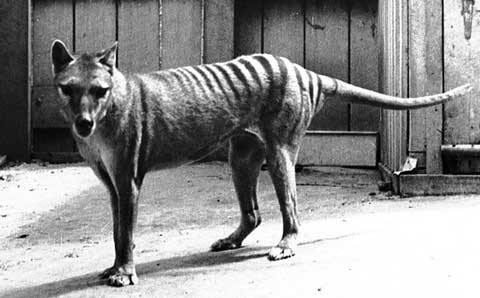
The last known thylacine died in captivity at a zoo in Hobart, Tasmania on September 7th 1936. The species was officially declared extinct by the International Union for Conservation of Nature (IUCN) in 1986. How did this happen?
In short, the Tasmanian tiger, also known as the thylacine, became extinct due to a combination of factors, especially hunting, habitat loss, and disease. It was already in small numbers and confined to the island of Tasmania when Europeans arrived. Hunters with guns soon decimated what was left of the species.
Let’s explore more about the fate of this intriguing animal.
What Happened to the Tasmanian Tiger?
The fate of the Tasmanian Tiger has been the subject of intense debate and investigation since the last known Thylacine died in captivity on 7 September 1936.
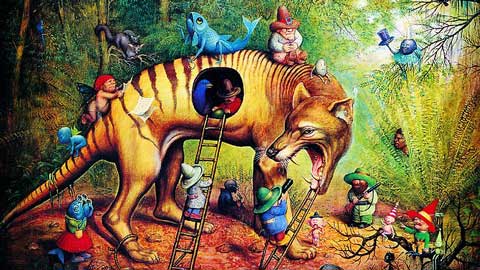
CFZ Zoological Director Richard Freeman has told the Guardian newspaper that he has “no doubt” the species still exists“. According to Freeman,
The area is so damn remote, there are so many prey species and we have so many reliable witnesses who know the bush that I’d say there is a reasonable population of them left. … The people who say they’ve seen it have nothing to gain and everything to lose. I’d say there is a population of at least 300 of them.
Hunting, Habitat Loss and Disease
The fossil record provides evidence that the thylacine lived on mainland Australia, to perhaps around 2,000 years ago. Competition from dingoes may have wiped out the species there. It was left vulnerable and isolated and, therefore, unable to withstand modern hunting.
Hunting: The thylacine was hunted extensively by European settlers in Tasmania, Australia, who saw the animal as a threat to their livestock. Bounty schemes were put in place to encourage hunting of the thylacine, and by the early 20th century, the species was considered to be rare.
Habitat loss: The arrival of Europeans in Tasmania also led to the destruction of the thylacine’s natural habitat, as forests were cleared for agriculture and urban development. This reduced the animal’s range and made it harder for them to find food and shelter.
Disease: Some scientists have also suggested that disease may have played a role in the thylacine’s extinction. The thylacine was known to be susceptible to the same diseases as domestic dogs, and it’s possible that diseases such as distemper or mange were introduced to the population by domestic dogs.
Disappearance from Mainland Australia
The thylacine, also known as the Tasmanian tiger, was native to Tasmania, an island state of Australia. But there is evidence that it also lived on mainland Australia in the past.
Fossils of the thylacine have been found at various sites across the mainland, including the Nullarbor Plain, Victoria, and New South Wales, dating back to around 2,000 years ago. These fossils provide evidence that the thylacine once had a wider distribution than just Tasmania and that it lived on the mainland at least until the time of human arrival.
The fossil record is incomplete and some gaps exist, and it’s not entirely clear when the thylacine went extinct on the mainland.
Some scientists believe that the thylacine may have persisted on the mainland for much longer than the current evidence suggests, and that it may have become extinct on the mainland only relatively recently.
Other scientists propose that the thylacine became extinct on the mainland around 2,000 years ago, possibly due to competition with dingoes (wild dogs) or due to changes in climate.
Tasmanian Tiger Sightings
The Tasmanian tiger is a species of marsupial that is believed to have become extinct in the 20th century. Despite this, there have been occasional reports of sightings of the animal, particularly in Tasmania, Australia, where it was native.
However, most experts believe that these sightings are likely to be of other animals or misidentifications, and there is no concrete evidence to suggest that the Tasmanian tiger still exists.
Some of the most credible sightings have been reported by people who have had previous experience with the Tasmanian tiger, such as park rangers, zookeepers, and naturalists.
One example is David Fleay who is a naturalist, he reported that he saw a thylacine in the wild in Western Tasmania in the early 1940s. Another example is the sightings of thylacine in south-western Tasmania by Wilf Batty, a farmer and hunter, in the early 1980s.
However, it’s worth noting that even these credible sightings can’t be considered as definitive proof of the animal’s existence. The lack of concrete evidence such as photographs, video footage, or physical specimens make it difficult to confirm the existence of the Tasmanian tiger.
But is Survival of the Species Plausible?
There is no doubt that Tasmania has plenty of remote wilderness that is rugged and virtually impenetrable to humans. It is possible that, if native animals were living in the thick bush, they could go for quite some time without detection.
But there are two very good reasons why we can be sure the Tasmanian Tiger is extinct.
The first is that the Thylacine was struggling to survive before European settlers arrived in Australia. It was already extinct or almost extinct on mainland Australia.
Interestingly, Queensland Museum paleontologists recently found a Tasmanian Tiger tooth in central Queensland. The tooth was deposited prior to rainforest being replaced by a more arid environment, suggesting a climate change cause of local extinction. The issue is one for the paleoecology branch of paleontology.
The Tasmanian population was stronger but numbers were quickly decimated by hunters.
Tasmanian farmers really hated the carnivorous marsupial. VV Hickman, a biology professor at the University of Tasmania, wrote in 1955:
a single thylacine often killed several sheep in a night, merely sucking their blood and eating a little of the kidney fat.
Second, the only “evidence” we have of the species continuing beyond the 1930s are “eyewitness” accounts. These are not plausible.
Lessons from the Bigfoot Phenomenon
Anyone who has watched Bigfoot Hunters has had the opportunity to starkly see the fallibilities of human perception. These guys are hunting for giant human-like creatures who apparently live quite close to populated areas.
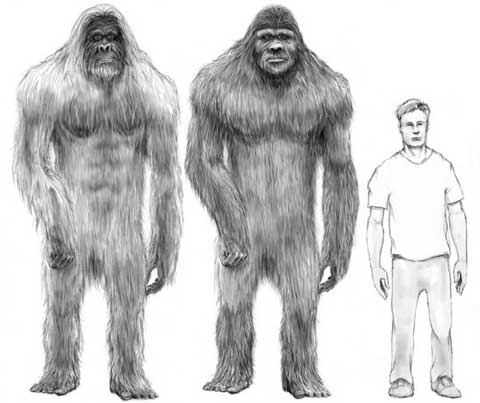
Without any firm evidence emerging, there is no other sensible conclusion to draw: bigfoots simply don’t exist. It would be impossible for a large creature with human-like needs to maintain a viable population and go undetected.
And yet there is no shortage of bigfoot believers. Every Bigfoot Hunters episode draws out multiple eyewitnesses swearing to have seen these mythical creatures.
The bigfoot phenomenon demonstrates that, by themselves, eyewitness accounts of seeing a rare creature do not constitute evidence of its existence.
Tasmanian Tiger vs Bigfoot
The Tasmanian tiger and Bigfoot (also known as Sasquatch) are two very different animals. But they’re often compared due to their elusive nature, plus the fact that they’re both believed by some to still exist despite being officially declared extinct or unproven.
The Tasmanian tiger, also known as the thylacine, was a marsupial that was native to Australia and was believed to have become extinct in the 20th century. There have been occasional reports of sightings of the animal, but most experts believe that these are likely to be of other animals or misidentifications. There is no concrete evidence to suggest that the Tasmanian tiger still exists.
Bigfoot, on the other hand, is a cryptid, an animal whose existence or survival is disputed or unsubstantiated. It is said to inhabit forests, mainly in North America. The creature is usually described as a large, ape-like being, and there have been many reported sightings, footprints and vocalizations attributed to it. Most scientists and experts consider the evidence for Bigfoot’s existence to be weak and often based on anecdotal evidence. The majority of scientific community doesn’t consider the existence of Bigfoot as credible.
In summary, the Tasmanian tiger is a known species that is believed to have become extinct, while Bigfoot is a cryptid whose existence is disputed.
Ah, the Tasmanian Tiger – a creature as elusive as a good parking spot in Hobart! While some folks still claim to have seen one, citing eyewitness accounts as solid proof (perhaps they mistook a particularly grumpy kangaroo?), the evidence just aint there. It’s like believing Bigfoot exists based solely on grainy footage and second-hand stories. Without a concrete specimen or some undeniable proof, Im sticking to the science. The poor thylacine was already on the ropes before Europeans arrived, facing habitat loss and a bounty placed on its head like it was a notorious criminal. Its plausible it hid away in some remote corner, but plausible isnt proof. Until we find more than just stories, lets keep the Ewoks as our official endangered species mascots!
While the evidence for the thylacines extinction is quite compelling, one cant help but chuckle at the persistent eyewitness reports, reminiscent of the Bigfoot phenomenon. Its fascinating how human perception can play tricks, leading to sightings of creatures that, logically, couldnt maintain a viable population undetected. Tasmanias wilderness is rugged, but even so, the idea of a carnivorous marsupial slipping away unnoticed for decades is almost comical. Its a reminder that belief without concrete evidence, no matter how passionate the eyewitnesses, isnt proof. The thylacines story, sadly, underscores the harsh reality that sometimes, even the most intriguing sightings dont change the inevitable outcome.
While the article presents a compelling case, I found myself chuckling at the sheer *conviction* of the experts discounting modern sightings. Its almost as if theyve declared the Tasmanian Tiger Extinct™ and are now collectively refusing to let it come back for tea. The lessons from Bigfoot are amusingly spot-on – unless theres actual *firm evidence*, those eyewitness accounts remain tantalizingly like a thylacines blood-sucking reputation. Maybe we should consider the possibility, however slim, that just like those Queensland teeth, something interesting might still be hiding in the bush, waiting to be rediscovered. Or perhaps its just more compelling than Bigfoot, despite the lack of proof!
While the article presents a thorough, scientific takedown of the Thylacines survival prospects, I found myself chuckling at the Bigfoot analogy. Its almost as if scientists are saying, Look, folks, even if a giant, shaggy humanoid *could* hide in plain sight, the sheer impracticality and lack of solid proof mean its probably best to accept the absence, much like the Thylacine. Its a bit like explaining to a child why Santa Claus, while a wonderful idea, isnt technically residing in the North Pole with reindeer. Solid science, with a healthy dose of festive skepticism!
Ah, the thylacine – Australia’s very own Extinction Mascot! Its fascinating how even with plausible extinction factors like hunting, habitat loss, and maybe a bad case of mange, some folks still cling to those eyewitness accounts. Its like the Bigfoot phenomenon, isnt it? Just because someone swears they saw something doesnt mean its trotting around undetected. Were humans, prone to seeing things! The evidence, or lack thereof, points firmly to extinction, but I suppose hope springs eternal. Who knows, maybe a thylacine is hiding in Tasmanias impenetrable bush, plotting its revenge for the 20th century. Until photos or a tooth surface, Ill stick to believing the science – and maybe avoid camping out in the rugged wilderness!